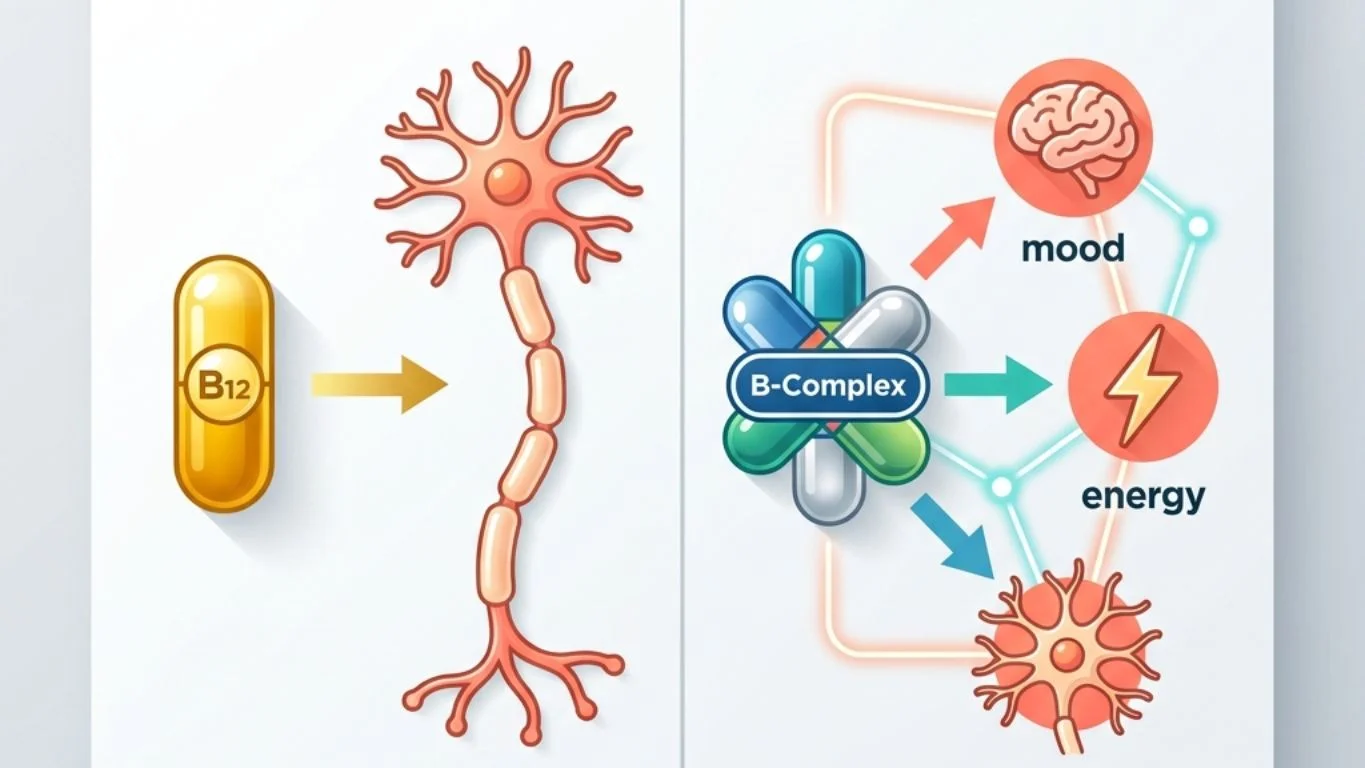
What Are Active B Vitamins?
Some B vitamins are available in more than one form. Standard forms are widely used and well-established, while active forms are closer to the form the body works with — often requiring fewer conversion steps before use
Common examples include:
- Methylcobalamin — an active form of Vitamin B12
- Pyridoxal-5-Phosphate (P5P) — an active form of Vitamin B6
- Benfotiamine — an advanced form related to Vitamin B1, with higher tissue availability
Interest in these forms comes from the fact that some users prefer formulas built on more specialized ingredients — especially when their goal is specifically related to nerve support rather than general nutritional coverage
Why Do Some Users Pay Attention to This?
When searching for a nerve support product, many users want a formula that feels intentional — not a broad supplement with a vague message. That's why users comparing options often ask questions like:
- Is this formula designed for nerve support, or is it a general B-complex?
- Are the ingredient forms commonly associated with more specialized products?
- Does the label reflect attention to formulation detail?
Active forms may be part of a bigger picture that makes a product appear more specialized — but they don't settle the decision on their own
Are Active Forms Always Better?
Not necessarily. Active forms can be a meaningful feature, but the word "active" alone doesn't determine product quality. A more useful evaluation considers several factors together:
- What is the product's stated purpose?
- Is the formula coherent — do the ingredients relate to one another?
- Are the dosages reasonable?
- Is the product designed for a specific category, or does it try to cover too much?
Active forms can be an important feature — but they're one part of the picture, not the whole story
Standard vs Active Forms: A Quick Comparison
The table below compares the common and active forms of B1, B6, and B12
Thiamine HCl
Benfotiamine
Pyridoxine HCl
Pyridoxal-5-Phosphate
Cyanocobalamin
Methylcobalamin
How to Evaluate a B Vitamin Formula for Nerve Support
Rather than focusing on a single ingredient name, it's more useful to assess the full picture:
1) Clarity of Purpose
Is the product clearly positioned for nerve support? Or is it a general formula with a broad, undefined message?
2) Ingredient Relevance
Are the chosen ingredients commonly associated with nerve support content? Does the formula feel intentional or random?
3) Formula Coherence
It matters that the ingredients work together logically — not just that each one looks good individually
4) Transparency
A good product in this category makes the reasoning behind its formulation understandable — not just impressive-sounding
What Dosage Information Should You Actually Check on the Label?
For nerve support formulas specifically, ingredient presence is only half the picture. The dosage listed matters as much as the form used. Here is what to look for:
Methylcobalamin
Clinical nerve support studies typically use 500mcg–1500mcg daily. If the label lists mcg in the single digits or does not specify the B12 form, it is worth noting.
Pyridoxal-5-Phosphate (P5P)
P5P is the active coenzyme form of B6. Verify it is listed as P5P or Pyridoxal-5-Phosphate specifically — not just "Vitamin B6" which could indicate the standard Pyridoxine HCl form.
Benfotiamine
Should be listed by name as Benfotiamine — not as Thiamine or Vitamin B1 alone. The BENDIP trial used 300mg/day. Supplement doses are typically lower, but the form name should be explicit.
Formula Coherence
Check whether these three forms appear together in the same product at stated dosages — not just one active form alongside standard forms of the others.
Where Does a Product Like Cobascore Fit?
For users comparing formulas in this category, a product like Cobascore may feel more relevant when they are specifically reviewing active-form ingredients as part of a broader nerve support formula
Its composition includes Benfotiamine, Pyridoxal-5-Phosphate, and Methylcobalamin — which are the types of ingredients often highlighted in more specialized formulas in the nerve support space
This doesn't represent a therapeutic promise — but it helps explain why some users see it as a logical option for comparison when searching for a more specific formula in this category


Have a question about active B vitamins or nerve support formulas? Chat with us on WhatsApp
Frequently Asked Questions
Important Disclaimer
The content on this page is for informational and educational purposes only. It is not a substitute for medical advice, diagnosis, or treatment. Please consult a qualified healthcare professional when needed
- Watanabe T, et al. — Ultra-high dose methylcobalamin promotes nerve regeneration. J Neurol Sci, 1994. PubMed
- Stracke H, et al. — Benfotiamine in diabetic polyneuropathy (BENDIP). Exp Clin Endocrinol Diabetes, 2008. PubMed
- Obeid R, et al. — Vitamin B12 status in relation to MMA, homocysteine. Clin Chem Lab Med, 2007. PubMed
- Banerjee R, Ragsdale SW. — The many faces of vitamin B12. Annu Rev Biochem, 2003. PubMed
- di Salvo ML, et al. — Biomedical aspects of pyridoxal 5'-phosphate availability. Front Biosci, 2012. PubMed