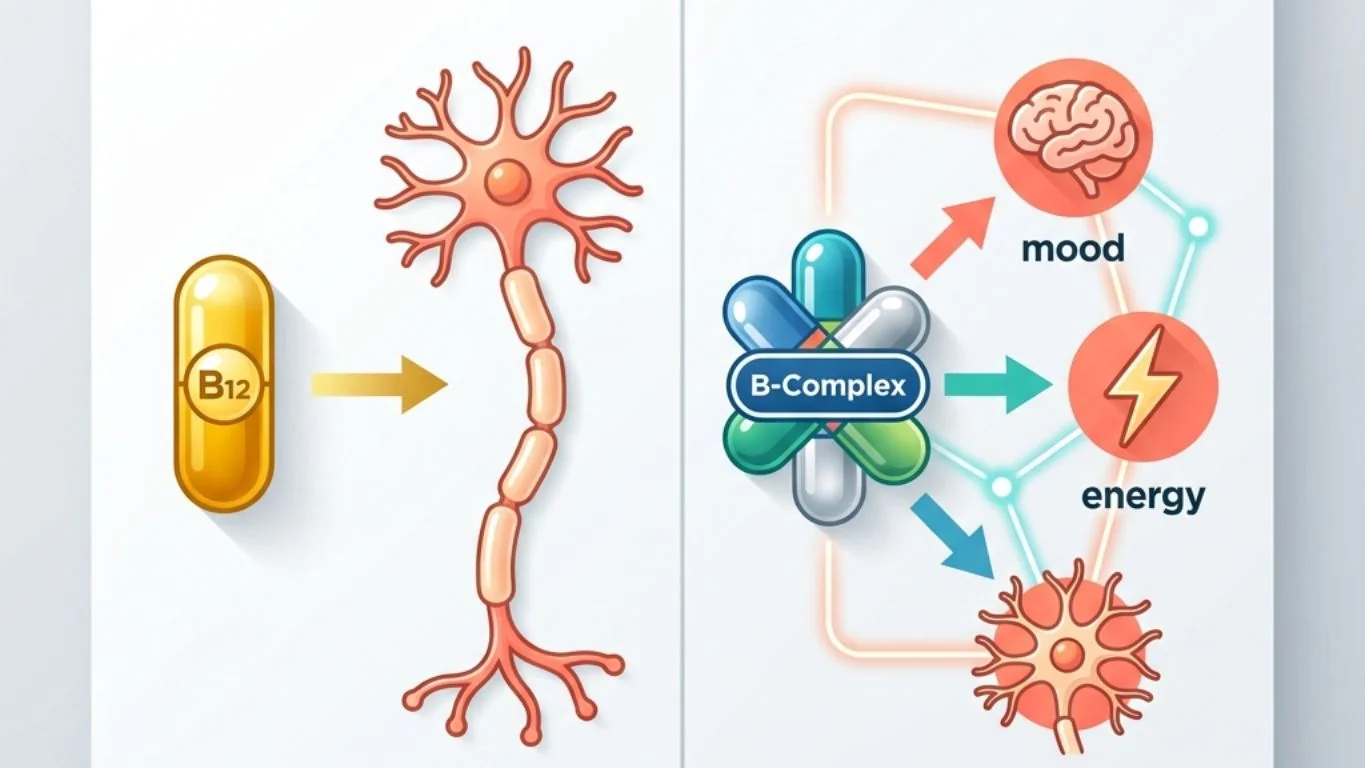
What does a nerve support supplement actually do?
Nerve support supplements provide key B vitamins in their active bioavailable forms — primarily Methylcobalamin (active B12), Benfotiamine (fat-soluble B1), and active B6 (Pyridoxal-5-Phosphate). Unlike conventional B vitamin forms that require conversion in the liver before the body can use them, these active forms are directly usable by nerve cells
These nutrients play essential roles in maintaining the myelin sheath (the protective coating around nerve fibers), supporting nerve conduction velocity, and aiding in nerve cell regeneration. When deficiency occurs — whether from poor diet, absorption issues, or increased demand — nerve function can gradually decline, leading to symptoms like tingling, numbness, and weakness
Which B vitamins support nerve health?
Methylcobalamin (Active B12)
The neurologically active coenzyme form of B12. Functions as a methyl donor in the methionine synthase → SAMe pathway, which is the rate-limiting step for myelin phospholipid synthesis. Unlike cyanocobalamin, it does not require MMACHC-mediated decyanation before entering the methyl cycle — making it directly available to Schwann cells for myelin repair
Learn more →Benfotiamine (Fat-soluble B1)
A lipid-soluble thiamine prodrug that bypasses the saturable THTR-1/THTR-2 intestinal transporters used by standard thiamine HCl. Absorbed via passive diffusion, achieving 5× higher intracellular thiamine concentrations (Schreeb et al., 1997). Activates transketolase in the pentose phosphate pathway, diverting glucose metabolites away from AGE-forming and PKC-activating pathways implicated in diabetic neuropathy
Learn more →Active B6 (Pyridoxal-5-Phosphate)
The coenzyme form of B6, already phosphorylated and ready for neurotransmitter synthesis (serotonin, GABA, dopamine). Standard pyridoxine requires hepatic phosphorylation by pyridoxal kinase — a step that is rate-limited in patients taking levodopa, isoniazid, or oral contraceptives. P-5-P bypasses this entirely
Learn more →Active forms vs standard forms — what's the difference?
| Property | Active forms | Standard forms |
|---|---|---|
| Bioavailability | Enters metabolic pathways without enzymatic conversion — directly usable as coenzymes by nerve tissue | Requires hepatic conversion (MMACHC decyanation for B12, phosphorylation for B6) before becoming metabolically active |
| Absorption mechanism | Benfotiamine: passive lipid diffusion (5× intracellular levels). Methylcobalamin: bypasses MTRR conversion step | Thiamine HCl: saturable THTR-1/THTR-2 transporters. Cyanocobalamin: requires multi-step hepatic processing |
| Clinical relevance | Preferred when conversion is impaired: MTHFR variants, metformin use, age >50, gut malabsorption, or confirmed neuropathy | Sufficient for general maintenance in healthy individuals with no conversion-limiting factors |
| Examples | Methylcobalamin, Benfotiamine, P-5-P | Cyanocobalamin, Thiamine HCl, Pyridoxine HCl |
Who typically looks for nerve support?
The decision to seek a nerve support supplement usually follows a specific pattern — not general wellness interest, but a response to symptoms or a clinical finding that standard approaches haven't resolved.
"I've had tingling for weeks and my doctor found low B12"
This is the most common entry point. Confirmed B12 deficiency with neurological symptoms (tingling, numbness, gait changes) is where active-form supplementation has the strongest clinical rationale — methylcobalamin delivers the coenzyme directly to nerve tissue without hepatic conversion.
B12 and nerve symptoms →"I've been taking a regular B-complex but my symptoms haven't improved"
This suggests the conversion bottleneck is relevant. Standard cyanocobalamin and pyridoxine require enzymatic conversion (MTRR, hepatic B6 phosphorylation) that can be limited by genetics, age, gut health, or medication use. Switching to active forms eliminates this variable.
Why active forms matter →"I have diabetes and my doctor mentioned peripheral neuropathy"
Diabetic peripheral neuropathy involves both metabolic nerve damage (AGE accumulation, oxidative stress) and potential B12 depletion from metformin use. Benfotiamine addresses the metabolic pathway via transketolase activation and AGE inhibition; methylcobalamin supports myelin repair. This dual mechanism is why both are studied together in diabetic neuropathy trials.
Benfotiamine for nerves →What to look for in a nerve support supplement
This content is for educational and awareness purposes only, and is not a substitute for medical diagnosis or treatment. If you have persistent or worsening symptoms, consult your doctor
From checklist to formula — how Cobascore maps to the criteria above
The checklist above is not abstract — each criterion maps to a specific formulation decision. Why Methylcobalamin over Cyanocobalamin? Because cyanocobalamin requires removal of its cyanide group via the MMACHC decyanation pathway before it can enter the methyl cycle. Why Benfotiamine over thiamine HCl? Because thiamine HCl is water-soluble and absorbed through saturable THTR-1/THTR-2 transporters, while benfotiamine is lipid-soluble and enters cells via passive diffusion — achieving 5× higher intracellular concentrations. Why P-5-P over pyridoxine? Because pyridoxine requires hepatic phosphorylation by pyridoxal kinase, a step that is rate-limited in patients taking levodopa, isoniazid, or oral contraceptives
If your symptoms are mild, your B12 is normal, and you have no conversion-limiting factors, a standard B-complex may be sufficient. Cobascore is designed for the subset of users where the conversion bottleneck is clinically relevant


Need iron support too?
If you have anaemia or fatigue alongside nerve symptoms, Hemascore provides gentle iron bisglycinate — 36 mg elemental iron per capsule