Quick Summary
- B12 deficiency nerve symptoms include tingling, numbness, burning feet, and balance problems — they often appear late and mimic other conditions
- Neurological damage can begin at serum B12 levels considered 'normal' by standard lab ranges
- MMA testing is more sensitive than serum B12 alone for detecting functional deficiency
- Early supplementation can reverse symptoms; prolonged deficiency may cause irreversible nerve damage
- Methylcobalamin (the active form) is more compatible with the nervous system than cyanocobalamin
Tingling in your fingers. Numbness in your feet that won't go away. The feeling that a part of your body is "asleep" and won't wake up. This page helps you answer one question: could this be B12? Use the checklist below to screen your symptoms, understand the severity levels, and know exactly when to ask your doctor for MMA testing. (Want to understand how B12 actually repairs nerve damage? Read the science →)
Why is Vitamin B12 So Important for the Nerves?
Vitamin B12 isn't just an "energy vitamin" as commonly believed. It plays two critical roles in the nervous system:
Building and maintaining the myelin sheath
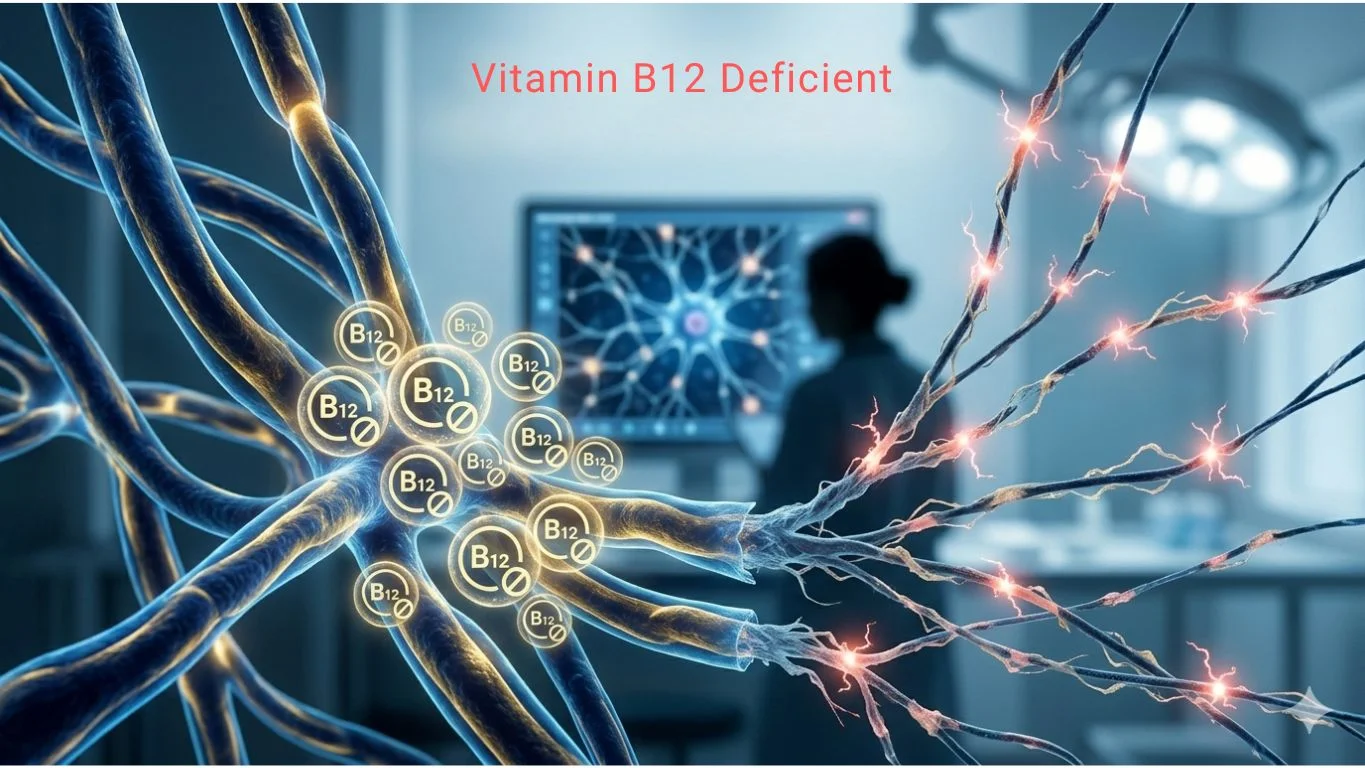
Every nerve is wrapped in an insulating layer called the myelin sheath — think of it as the plastic coating around an electrical wire. B12 is essential for building and maintaining this layer. When B12 is low for a long time, the myelin gradually deteriorates and nerve signals slow down or arrive incomplete
Keeping homocysteine in check
B12 helps convert homocysteine into safe compounds. When B12 drops, homocysteine rises — and elevated homocysteine damages the tiny blood vessels that feed your nerves. So B12 both builds and protects
Want the full biochemistry? Read how B12 repairs nerve damage through two biochemical pathways →
Diagnostic Thresholds
| Marker | Normal | Borderline | Deficient |
|---|---|---|---|
| Serum B12 | >400 pg/mL | 200–400 pg/mL | <200 pg/mL |
| MMA | <0.4 μmol/L | — | >0.4 μmol/L |
| Homocysteine | <10 μmol/L | 10–15 μmol/L | >15 μmol/L |
| MCV | 80–100 fL | — | >100 fL (macrocytic) |
Important: 25–30% of B12-deficient patients with neurological symptoms have normal haematology — meaning MCV and CBC look fine while nerves are already damaged. This is why MMA testing is critical when serum B12 is borderline (200–400 pg/mL)
When B12 remains low for an extended period, the myelin sheath slowly degrades, making nerve signals slower or less precise. This scientifically explains why a deficiency impacts sensation, movement, and focus all at once
The 4 Most-Searched Neurological Symptoms of B12 Deficiency
Here are the primary neurological symptoms people commonly associate with B12 deficiency and nerve weakness
Note: Experiencing these doesn't guarantee a B12 deficiency, but they are the most common triggers for seeking a medical evaluation
1. Numbness and Tingling in the Limbs
This is the most common symptom people search for. It is often described as "pins and needles," a "sleeping" limb, or a "mild electric shock" in the fingers, hands, or feet. In a B12 context, this indicates compromised signal transmission in peripheral nerves (peripheral neuropathy). However, poor circulation or prolonged sitting can cause similar feelings
2. Heaviness or Weakness in the Hands and Feet
Instead of tingling, some feel an unexplained heaviness, weak grip, or feet that tire quickly while walking. If this is constant and unrelated to physical exertion, it requires attention. Advanced B12 deficiency can affect motor nerves, not just sensory ones
3. Difficulty Balancing or Feeling Unsteady
This is a less searched but more concerning symptom. You might notice poor balance when walking in the dark or on uneven ground, or feel like your feet aren't properly "sensing" the floor. Severe B12 deficiency can impair the sensory nerves responsible for sending posture and balance data to the brain
4. Brain Fog, Poor Concentration, and Mood Swings
Not all B12 symptoms are strictly physical. You might experience unexplained difficulty focusing, unusual forgetfulness, or a mental "fog." Because B12 helps synthesize neurotransmitters that affect mood and focus, these symptoms make biological sense—though they can also stem from stress, sleep deprivation, or thyroid issues
Why Don't Neurological Symptoms Appear Immediately?
Many people wonder: "How could I have a B12 deficiency for years and not know?"
The answer lies in how your body works. The liver stores enough B12 to last for years. This means your reserves deplete very slowly, without clear early warning signs. When symptoms finally start, they are often subtle: mild tingling blamed on fatigue, exhaustion blamed on work stress, or forgetfulness blamed on a busy schedule
Because the body compensates over time, symptoms accumulate silently rather than hitting you all at once. This makes early detection difficult until the symptoms reach a point where they can no longer be ignored
Who's at higher risk?
B12 deficiency becomes more worth considering as a cause of tingling when specific risk factors are present:
- Strict vegan diet without supplementation — B12 is found almost exclusively in animal products
- Long-term PPI or antacid use — these reduce gastric acid needed for B12 liberation from food
- Metformin use for diabetes — interferes with B12 absorption in the terminal ileum
- Age >60 — declining intrinsic factor production reduces B12 absorption efficiency
- Pernicious anaemia — autoimmune destruction of intrinsic factor-producing parietal cells
- Prior gastric or ileal surgery — removes absorption sites for B12
Similar Symptoms That Might Not Be B12
It is crucial to understand that numbness, tingling, and nerve weakness are not exclusive to B12 deficiency
| Symptom | Link to B12 Deficiency | Other Possible Causes |
|---|---|---|
| Numbness & Tingling | ✓ Likely in chronic deficiency | Pinched nerves, diabetes, poor circulation |
| Heaviness & Weakness | ✓ In advanced stages | Herniated discs, muscle diseases |
| Balance Issues | ✓ In severe deficiency | Inner ear problems, blood pressure issues |
| Brain Fog & Mood Swings | ✓ A possible connection | Lack of sleep, thyroid disorders, anxiety |
Common alternative causes to consider:
- Diabetes: Diabetic neuropathy is a leading cause of numbness and is frequently confused with B12 deficiency
- Hypothyroidism: Causes neurological and cognitive symptoms very similar to low B12
- Vitamin D Deficiency: Highly prevalent globally and impacts neuromuscular function
- Pinched Nerves: Often resulting from poor posture or a herniated disc
- Anxiety and Stress: Can produce very real physical sensations that are easily misinterpreted
Therefore, a proper medical evaluation is the only way to be sure—don't just settle for one explanation
When Should You Get a Medical Evaluation?
Not every case requires the same level of urgency. Here is a priority guide:
- Balance issues or motor weakness that affects your daily life
- Symptoms that progressively worsen over time and do not improve on their own
- Persistent symptoms not linked to a specific posture or activity
- Chronic fatigue accompanied by paleness or poor focus
- Following a strict vegan diet for a long time without supplements
- Regularly taking antacids (like omeprazole or famotidine) for months or years, as they can reduce B12 absorption
- Pregnancy or breastfeeding
- Taking Metformin for diabetes
In these cases, a simple B12 blood test is an easy first step that can give you a much clearer picture
How Do Active Forms of B12 Affect the Nerves?
Not all forms of B12 reach the nerves in the same way
Cyanocobalamin (the cheaper, traditional form) needs a conversion step in the liver before it becomes active. Not everyone converts it efficiently
Methylcobalamin arrives ready to use — it goes straight to work supporting myelin maintenance without the extra conversion step. For nerve support specifically, the active form is the more direct option
Multi-B approach: Nerve function depends on more than B12 alone. Combining methylcobalamin with benfotiamine (active B1) and P5P (active B6) covers myelin building, nerve energy, and neurotransmitter balance simultaneously
For the detailed biochemistry of how each form works at the cellular level, see: How Vitamin B12 Repairs Nerve Damage →
Or if you'd like to learn about a formula designed around these active forms, you can explore Cobascore — Active B-Complex for Nerve Support
Summary
Neurological symptoms like tingling, numbness, and limb weakness can be an indicator of Vitamin B12 deficiency. However, these symptoms are shared by many other conditions, and you cannot determine the cause just by reading about it online
What you can do now: If these symptoms are persistent or worsening, a simple B12 blood test and a chat with a doctor can give you a real answer instead of leaving you to guess. The right explanation is the best cure for anxiety