Quick Summary
- "Gentle on the stomach" doesn't mean iron is fully absorbed before the colon — it means less unabsorbed iron tends to reach it.
- Unabsorbed iron reaching the colon is one proposed contributor to constipation in some people, alongside dose, formulation, and individual tolerance.
- Every label lists a compound weight, but elemental iron is the figure that matters for comparing doses.
- For many people one dose a day is enough — hepcidin can blunt what a second same-day dose adds.
- Iron deficiency is not only a women's issue — in men the cause needs investigating, not just replacing.
What Does "Gentle on the Stomach" Actually Mean?
You start iron tablets, and within days your gut has stopped, your stomach feels raw, and you seem stuck between two bad options: push through and suffer, or stop and let the fatigue and dizziness come back. Someone probably told you "your stomach is sensitive, take it with food" — and it barely helped.
The problem is not you, and your stomach is not more sensitive than anyone else's. The problem is the form of iron itself.
"Gentle iron" does not mean a weaker dose or a weaker effect. It refers to forms designed so less unabsorbed iron tends to reach the colon — iron that ends up there is thought to be one contributor to constipation and cramping for some people, alongside dose, formulation, and individual tolerance.
The Problem Is Not Your Stomach — It Is Your Colon
Follow a single iron capsule through your body, because once you see the route you will know exactly why you feel unwell:
1Stop one — the stomach
The capsule dissolves and the iron is released. Older forms such as ferrous sulfate release "free" iron that can touch the stomach lining — thought to be one contributor to the nausea and burning some people feel not long after the tablet.
2Stop two — the small intestine
This is where your body takes what it needs. As a simplification: absorption is often pictured as passing through one narrow gate that can saturate quickly, though the real biology involves more than a single pathway.
3Final stop — the colon
Iron that isn't absorbed generally continues on to the colon. There it may irritate the lining and disrupt the local bacteria — one proposed contributor to the constipation some people experience.
Constipation is not a side effect you simply have to tolerate. It's often worth discussing with your doctor or pharmacist — in many cases it means a meaningful share of the iron you're taking isn't being absorbed and is reaching your colon instead.
This isn't theory. The largest analysis on the subject (Tolkien et al., 2015, pooling 43 studies) found that ferrous sulfate was associated with a significant increase in gastrointestinal side effects compared with placebo and some other ways of taking iron. If iron makes you feel unwell, you're far from alone.
Picture It This Way — One Gate or Two?
The simplest way to understand the difference between iron forms:
Conventional iron (ferrous sulfate)
As a simplification, picture a long queue at a single narrow gate. A few get through; the rest may pile up behind it — that backlog is one proposed contributor to constipation for some people.
Iron bisglycinate
Each iron atom is wrapped in a shell of a natural amino acid called glycine. That shell does two things:
- In the stomach: the iron stays inside the shell and rarely touches the stomach lining directly — one reason nausea is less common with this form
- At absorption: more than one route into the body has been proposed for this form, which may mean less unabsorbed iron is left over for the colon
The idea in one line: this form is designed so more iron may reach your blood and less is left for your colon. The "two gates" picture is a teaching device, not a settled clinical fact.
If you want the depth: the two proposed pathways are DMT1 and PepT1, though the exact absorption mechanics in humans are still being studied — the full numbers are in iron bisglycinate vs ferrous sulfate.
The Number on the Label — the Most Important Thing to Learn Before You Buy
This is the single most useful section here, because most people compare the wrong figure without realising it.
Every iron label lists a compound weight, and most people stop reading there:
1Compound weight
The big number on the box. Hemascore, for example, states 130 mg iron bisglycinate.
2Elemental iron
The pure iron inside that compound — the figure this article and product labels call elemental iron. In those 130 mg of bisglycinate, the elemental iron is 36 mg. (The remainder is the glycine — the protective shell itself.)
When comparing two iron products, the correct comparison is by elemental iron, not by compound weight. How much of that elemental iron your body actually absorbs is a separate question again — it isn't printed on any label, and it varies with your iron stores, the dose, and the person.
| Measure | Iron bisglycinate | Ferrous sulfate |
|---|---|---|
| Weight of the pill | 130 mg | 130 mg |
| Iron content inside it | ~28% | ~32% |
| Elemental iron | 36 mg | 42 mg |
Read that table carefully, because it inverts a common assumption:
Both pills weigh the same — 130 mg. And the sulfate actually holds more elemental iron inside it (42 mg against 36 mg). If the comparison stopped there, sulfate would look like the stronger choice.
But elemental iron content is only the starting point. How much of it your body actually absorbs, and how much continues on to the colon, depends on the chemical form, your current iron status, the dose, and other individual factors — it isn't something you can read off the label or calculate the same way for everyone. In comparative studies, chelated forms like bisglycinate are generally associated with better absorption and less unabsorbed iron reaching the colon than sulfate, which is one reason they tend to be better tolerated — but the exact numbers vary case by case.
So if someone tells you to "take a bigger dose", keep in mind that a higher dose generally means more iron for your gut to process, including more that may reach the colon unabsorbed — without necessarily improving how much actually gets into your blood.
How to choose a gentle iron supplement based on the science
The decision between iron forms is not a marketing question. It is a pharmacokinetic one. Based on the mechanisms above, a well-designed iron supplement should:
1Use a chelated form
Chelation is proposed to give the iron molecule access to an additional absorption pathway alongside DMT1, which may reduce how much free iron reaches the colon — the precise human absorption pathways are still being studied.
2Provide a moderate elemental iron dose
Rather than maximising per-tablet content. Very high doses can exceed what the body absorbs at once, which may increase colonic exposure without a matching benefit — the right dose depends on your iron status and is best set with your doctor.
3Include Vitamin C
Ascorbic acid reduces Fe³⁺ to Fe²⁺ at the enterocyte surface, enhancing absorption at the point of uptake without increasing GI distress.
4Be formulated for once-daily dosing
Splitting doses across the same day can trigger hepcidin-mediated suppression of the second dose. A single morning dose gives the hepcidin cycle time to reset before the next one.
5Avoid calcium-containing additives and fillers
Calcium competes directly with iron for DMT1 transporter binding. Fillers that alter gastric pH can affect dissociation and absorption rates.
The Second Thing Most People Do Not Know — Why One Daily Dose May Be Enough
Your body has a clever hormone called hepcidin whose job is to protect you from excess iron. The moment you take a dose, hepcidin rises and closes the absorption gates for hours — like a guard shutting the door and saying "that's enough for today".
Which means that if you take two doses a day, the second one may be absorbed less efficiently — so splitting the dose doesn't necessarily add much extra benefit, while still adding to what reaches the colon.
The practical takeaway: for many people, one dose a day is at least as efficient as two, and easier to tolerate. Some doctors prescribe iron every other day instead — that is not a mistake, it is based on a study published in Lancet Haematology (Stoffel, 2017) that found alternate-day dosing improved fractional absorption compared with consecutive daily dosing. But dose and timing are your doctor's call, based on your blood work and how depleted you are.
Iron Deficiency Is Not Only a Women's Issue
What delays diagnosis in men most is the assumption that anaemia is something that happens to women. In reality men develop iron deficiency too, for different reasons — and those reasons usually deserve a proper look:
- Slow, chronic bleeding from the digestive tract (an ulcer, haemorrhoids, or heavy painkiller use) — the most common cause in men, and easy to miss
- High physical workload — endurance athletes lose more iron
- Frequent blood donation
- A diet low in meat, or vegetarian
- Absorption problems such as coeliac disease or after stomach surgery
An important point specifically for men: if testing confirms iron deficiency, do not stop at the supplement — in men, iron deficiency is treated as a signal whose cause should be investigated with a doctor, not simply topped up. A supplement corrects the number; the cause still needs identifying.
The symptoms are the same in both: unexplained fatigue, breathlessness on mild exertion, dizziness, pallor, and poor concentration.
Five Practical Rules to Take Away From This Article
1Compare by actual iron, not the big number on the box
The big number is the compound weight, not the pure iron.
2If iron is making you unwell, ask about the form as well as the dose
For some people the form matters as much as the amount — worth reviewing both with your doctor rather than assuming a lower dose is the fix.
3For many people, one dose a day is enough
Hepcidin can blunt what a second same-day dose adds — ask your doctor whether splitting the dose helps in your case.
4Vitamin C supports absorption
Tea, coffee, milk and antacids reduce it — leave two hours between them and your iron.
5Consistency matters more than strength
The best supplement in the world does nothing if you stop after a week of feeling rough. Rebuilding iron stores takes months — and that stretch needs a form you can actually tolerate.
Hemascore — Built Around Exactly This
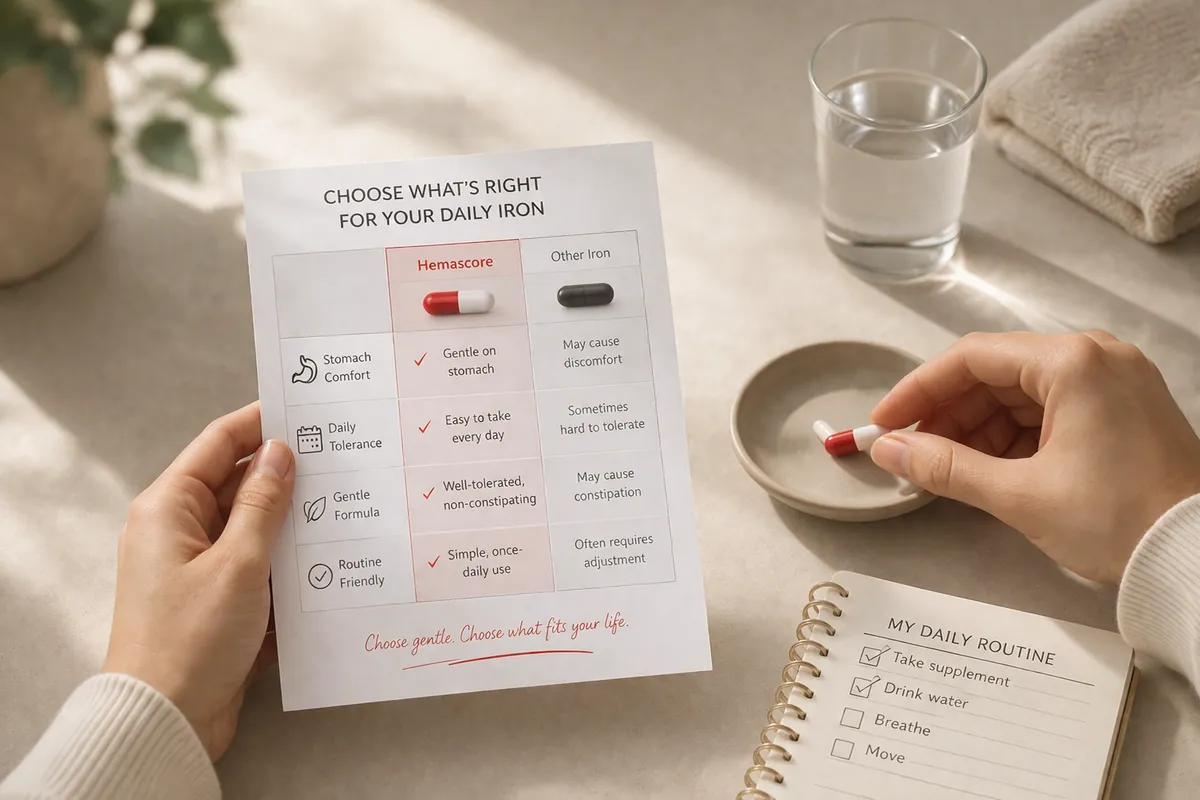
Everything above is precisely what Hemascore is built on:
- The form: iron bisglycinate — designed so the iron stays shielded through most of the stomach, which is associated with less free iron reaching the stomach lining
- The dose: 130 mg bisglycinate = 36 mg elemental iron — a moderate amount rather than a maximal one
- The formula: Vitamin C to support absorption, plus active B12 and active folate — one capsule a day
We are not telling you this is the "strongest" iron. We are telling you it is built so that you can stay on it — because that is what actually decides the outcome.
And if your stomach struggles with every iron you have tried, the iron for sensitive stomachs page walks through the available options and how they differ.