Quick Summary
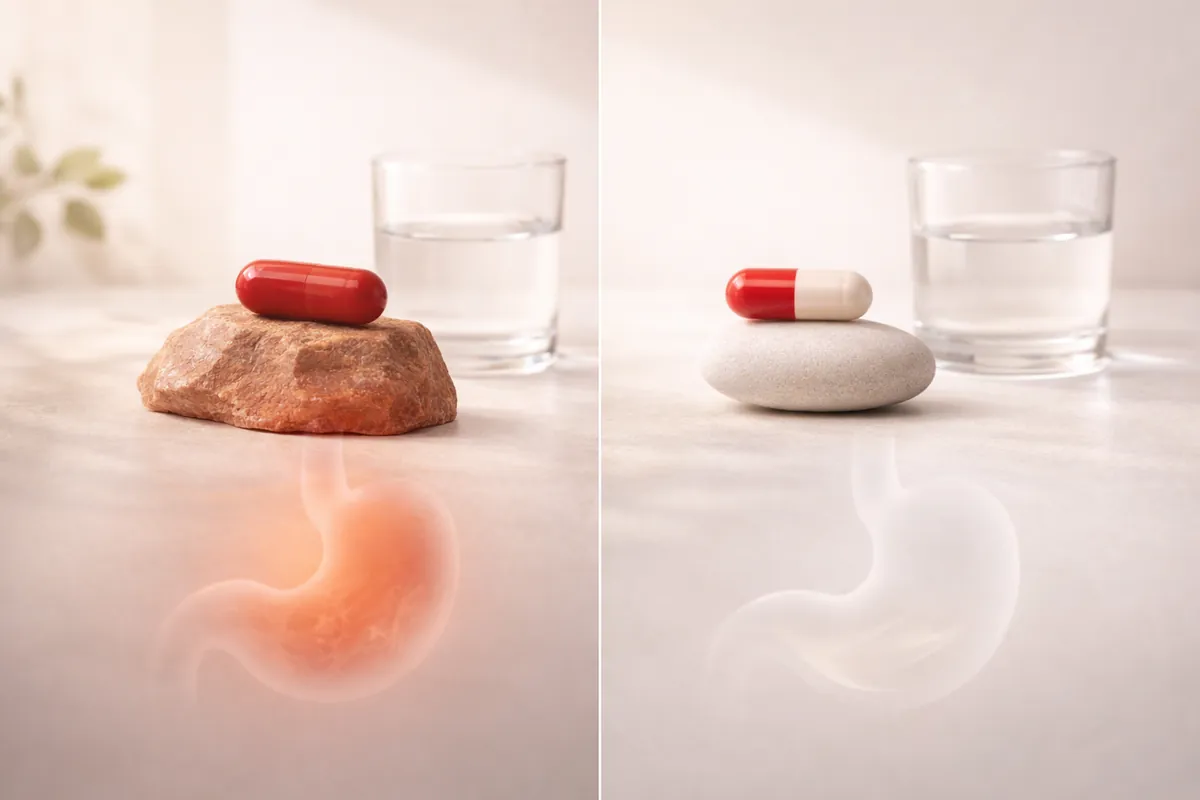
- Ferrous sulfate dissociates in the stomach, releasing free Fe²⁺ that triggers Fenton reactions.
- Bisglycinate stays chelated through the stomach — less free iron means less oxidative mucosal damage.
- Both forms raise hemoglobin effectively; bisglycinate does it with fewer GI side effects.
- Sulfate is cheaper per tablet, but bisglycinate's tolerability means better long-term compliance.
Quick Answer
Ferrous sulfate and ferrous bisglycinate deliver iron through fundamentally different pharmacokinetic pathways. Sulfate dissociates in gastric acid, releasing free Fe²⁺ ions that depend on the saturable DMT1 transporter. Bisglycinate stays chelated through gastric transit and — based on mechanistic evidence — is estimated to achieve 20–30% fractional absorption versus ~10% average for sulfate, with substantially less colonic free-iron spillover.
The practical difference: bisglycinate delivers more absorbed iron per milligram while generating fewer Fenton-reaction byproducts in the gut — which is why it is consistently associated with fewer GI side effects in clinical trials.
What Is Ferrous Sulfate? The Pharmacokinetics
Ferrous sulfate is the most prescribed iron salt globally. In dried form it is roughly 32% iron by weight, so a 130 mg dose — the same pill weight used in the comparison table below — carries approximately 42 mg of elemental iron.
When the tablet dissolves in gastric acid (pH 1–3), the sulfate dissociates completely, releasing free Fe²⁺ ions into the gastric lumen. These free ions must then be:
1.Reduced and transported via DMT1
Divalent metal transporter 1 (DMT1) on the apical membrane of duodenal enterocytes is the sole absorption pathway. DMT1 has limited capacity — it saturates at approximately 10% fractional absorption of a 42 mg dose.
2.The remaining ~38 mg passes to the colon
Unabsorbed free Fe²⁺ enters the colon, where it catalyzes the Fenton reaction: Fe²⁺ + H₂O₂ → Fe³⁺ + OH· + OH⁻. The hydroxyl radicals damage colonic mucosa, disrupt the Lactobacillus/Bifidobacterium microbiota balance (Zimmermann et al. 2010), and trigger the constipation, nausea, and epigastric pain reported in 30–50% of sulfate users.
The Fenton reaction also occurs in the stomach itself, where free Fe²⁺ attacks the mucus-bicarbonate barrier and stimulates vagal afferent nausea signals — explaining why gastric symptoms often appear within 30–60 minutes of dosing.
What Is Iron Bisglycinate? The Pharmacokinetics
Ferrous bisglycinate is an amino acid chelate where Fe²⁺ is bonded to two glycine molecules. This chelation is stable at gastric pH, meaning the iron does not dissociate into free ions in the stomach.
The absorption advantages are structural:
1.Dual-pathway absorption: DMT1 + PepT1
Because the chelate structurally resembles a dipeptide, mechanistic evidence suggests it may also be absorbed via the PepT1 peptide transporter in addition to DMT1. This dual-pathway advantage is estimated to increase fractional absorption to approximately 20–30% — roughly 2–3× the rate of ferrous sulfate.
2.Reduced colonic spillover
At estimated absorption rates, a 36 mg elemental bisglycinate dose yields approximately 7–11 mg absorbed and 25–29 mg colonic spillover. Compare this to 42 mg sulfate at ~10%: roughly 4 mg absorbed and 38 mg colonic. These are modelled estimates from a 130 mg dried ferrous sulfate pill — actual figures vary by product and individual iron status. The directional difference in colonic burden is the key point.
3.Minimal gastric Fenton burden
Because the chelate remains intact through gastric transit, there are no free Fe²⁺ ions to catalyze Fenton reactions in the stomach mucosa — eliminating the primary mechanism behind iron-induced nausea and epigastric pain.
Head-to-Head Pharmacokinetic Comparison
| Property | Ferrous Sulfate | Ferrous Bisglycinate |
|---|---|---|
| Weight of the pill | 130 mg | 130 mg |
| Iron content inside it (dried) | ~32% | ~28% |
| Actual (elemental) iron | 42 mg | 36 mg |
| Absorption pathway | DMT1 only | DMT1 + PepT1 (mechanistic evidence) |
| Fractional absorption (estimated) | ~10% average | ~20–30% |
| Reaches your blood (modelled) | ~4 mg | ~7–11 mg |
| Goes to your colon (modelled) | ~38 mg | ~25–29 mg |
| Gastric free Fe²⁺ | Yes — Fenton-active | No — chelated transit |
| GI side effects (Coplin 1991) | Tendency toward higher (overall difference not statistically significant) | Tendency toward lower |
| Hepcidin trigger intensity | High (large bolus dose) | Moderate (lower elemental dose) |
What Clinical Trials Show
Coplin et al. 1991 — Tolerability
The first head-to-head tolerability trial compared ferrous bisglycinate (bis-glycino iron II) against ferrous sulfate at equivalent elemental iron doses. The bisglycinate group showed a tendency toward fewer episodes of nausea, epigastric pain, and constipation — with greater preference for the chelate — though overall adverse-event incidence did not reach statistical significance in that trial. The result is consistent with a form-related rather than dose-related tolerability pattern, tied to reduced free-ion gastric exposure.
Szarfarc et al. 2001 — Absorption
Demonstrated that ferrous bisglycinate achieves higher fractional absorption than ferrous sulfate when tested in iron-replete subjects, consistent with the proposed dual DMT1 + PepT1 pathway advantage. The absorption difference widened further in iron-depleted subjects, where higher DMT1 expression amplified the chelate's advantage.
Milman et al. 2014 — Pregnancy
Randomised trial compared 25 mg elemental iron as ferrous bisglycinate against 50 mg elemental iron as ferrous sulfate in pregnant women. Haemoglobin and ferritin outcomes were comparable despite the bisglycinate arm receiving half the elemental dose — consistent with higher fractional absorption allowing equivalent iron delivery from a smaller dose.
Fischer et al. 2023 — Systematic Review
Meta-analysis confirmed non-inferior haemoglobin efficacy for ferrous bisglycinate across the reviewed populations. In pregnant women specifically, GI adverse events were 64% lower than with other iron salts — a statistically significant finding. In children, differences in iron outcomes did not reach statistical significance, likely due to the limited number of trials and design heterogeneity.
Why Hepcidin Timing Favors Bisglycinate
Hepcidin — the liver-produced iron-regulatory hormone — rises 6–8 hours after an iron dose and degrades ferroportin on enterocytes for approximately 24 hours (Moretti et al. 2015). During this window, iron trapped in enterocytes is lost when cells shed into the intestinal lumen after their 3–5 day lifecycle.
Ferrous sulfate's higher elemental dose (42 mg at the same pill weight) triggers a stronger hepcidin response. Stoffel et al. (2017) showed that consecutive daily doses are absorbed 35–45% less efficiently than alternate-day dosing — the same hepcidin mechanism makes a second same-day dose largely futile. Bisglycinate's lower elemental dose (25–36 mg) triggers a proportionally smaller hepcidin response while still delivering equivalent or superior absorbed iron — leaving a clearer window for the next day's dose.
Conclusion
The comparison between ferrous bisglycinate and ferrous sulfate is grounded in pharmacokinetic differences. Mechanistic evidence supports a dual DMT1 + PepT1 absorption advantage for bisglycinate, with estimated fractional absorption of 20–30% versus ~10% average for sulfate. The practical result: more iron absorbed per milligram, less colonic free-iron spillover, lower gastric Fenton burden, and — in clinical data — a tendency toward fewer GI side effects, with statistically significant tolerability advantage demonstrated in pregnant women (Fischer 2023).
For readers exploring iron options, the next logical step is understanding how to choose an iron supplement based on absorption pathways and elemental iron math, or learning about why iron feels heavy on the stomach through the Fenton mechanism. If you are specifically exploring a bisglycinate-based option, Hemascore is designed around this pharmacokinetic profile.